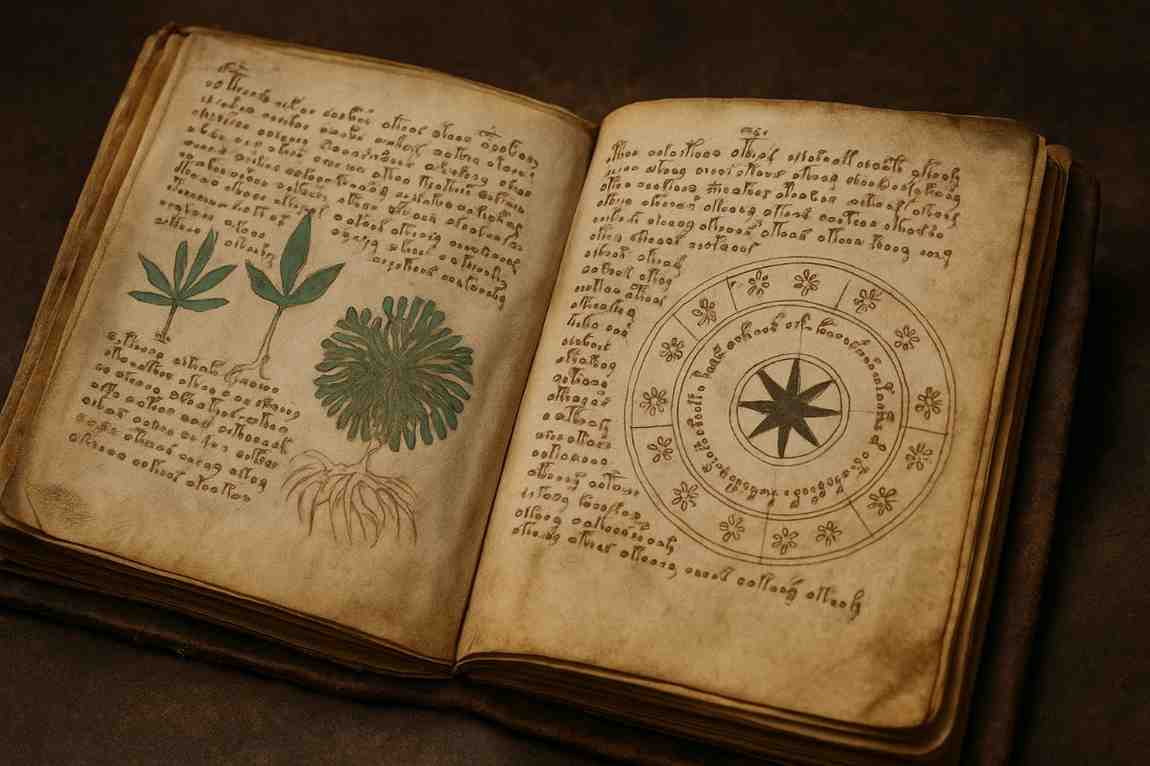
The Voynich Manuscript Mystery – One of the Biggest Mysteries in the World
Deep inside Yale University’s Beinecke Rare Book and Manuscript Library lies the only copy of a 240-page tome known as the Voynich manuscript mystery: a book written in an unknown language with drawings that seem stolen from a dream. Recently carbon dated to around 1420, its vellum pages features looping handwriting and hand-drawn images seemingly stolen from a dream. Real and imaginary plants, floating castles, bathing woman, astrology diagrams, zodiac rings, and sun’s and moons with faces accompany the text.
The name comes from Wilfrid Voynich, a Polish bookseller who came across the document at a Jesuit college in Italy 1912. He was puzzled. Who wrote it? Where was it made? What do these bizarre words and vibrant drawings represent? What secrets do its pages contain?
Origins and Enigma Behind the Voynich Manuscript
He purchased the manuscript from the cash-strapped priest at the college, and eventually brought it to the U.S., where experts have continued to puzzle over it for more than a century. Cryptologists say the writing has all the characteristics of a real language, just one that no one’s ever seen before. What makes it seem real is that in actual languages, letters and groups of letters appear with consistent frequencies, and the language in the Voynich manuscript has patterns you wouldn’t find from a random letter generator.
Other than that, we know little more than what we can see. The letters are varied in style and height. Some are borrowed from other scripts, but many are unique. The taller letters have been named gallows characters. The manuscript is highly decorated throughout with scroll-like embellishments. It appears to be written by two or more hands, with the painting done by yet another party. If ancient enigmas fascinate you, explore the Oracle of Delphi: how ancient prophecies worked.

Theories Explaining the Voynich Manuscript Mystery
Over the years, three main theories about the manuscript’s text have emerged.
- The first is that it’s written in cypher, a secret code deliberately designed to hide secret meaning.
- The second is that the document is a hoax written in gibberish to make money off a gullible buyer. Some speculate the author was a medieval con man. Others, that it was Voynich himself.
- The third theory is that the manuscript is written in an actual language, but in an unknown script. Perhaps medieval scholars were attempting to create an alphabet for a language that was spoken but not yet written.
In that case the Voynich manuscript might be like the rongorongo script invented on Easter Island, now unreadable after the culture that made it collapsed. Though no one can read the Voynich manuscript, that hasn’t stopped people from guessing what it might say.
Those who believe the manuscript was an attempt to create a new form of written language speculate that it might be an encyclopedia containing the knowledge of the culture that produced it. Others believe it was written by the 13th century philosopher Roger Bacon, who attempted to understand the universal laws of grammar, or in the 16th century by the Elizabethan mystic John Dee, who practiced alchemy and divination. More fringe theories that the book was written by a coven of Italian witches, or even by Martians.

Modern Research and Why the Mystery Still Endures
After 100 years of frustration, scientists have recently shed a little light on the mystery. The first breakthrough was the carbon dating. Also, contemporary historians have traced the provenance of the manuscript back through Rome and Prague to as early as 1612, when it was perhaps passed from Holy Roman Emperor Rudolf II to his physician, Jacobus Sinapius. In addition to these historical breakthroughs, linguistic researchers recently proposed the provisional identification of a few of the manuscript’s words.
Could the letters beside these seven stars spell Tauran, a name for Taurus, a constellation that includes the seven stars called the Pleiades? Could this word be Centaurun for the Centaurean plant in the picture Perhaps, but progress is slow. If we can crack its code, what might we find? The dream journal of a 15th-century illustrator? A bunch of nonsense? Or the lost knowledge of a forgotten culture? What do you think it is?
For another enduring puzzle, see why the Mona Lisa became so iconic.
Our Social Accounts


Impressive one ..
Keep growing my friend 😃😃…
Thank you my dear 😘