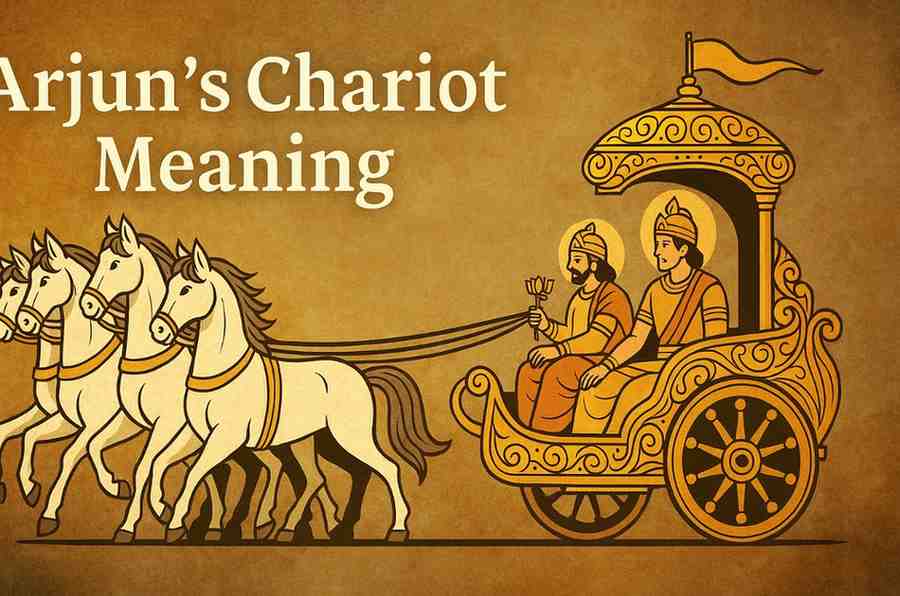
A deep meaning of Arjun’s chariot with five horses in Bhagavad Gita
Many consider the Bhagavad Gita one of the most profound spiritual works, full of timeless wisdom. The allegory of Arjuna’s chariot stands out among its many teachings as a particularly potent metaphor for comprehending the human situation. This metaphor appears in the Katha Upanishad and highlights self-control and the link between senses, mind, and intellect. In this article, we will explore the meaning of the Arjun’s chariot.
The Allegory of the Chariot: A Deep Symbolism
The Katha Upanishad presents the chariot allegory, but the Bhagavad Gita never mentions it directly. This allegory compares the body to a chariot, senses to horses, mind to reins, intellect to charioteer, and the soul to passenger. Deep insights into the essence of human life and the route to spiritual enlightenment are provided by this potent metaphor.
Arjun’s Chariot as a Metaphor
- The Chariot (The Body): This allegory compares the human body to a chariot. The body carries the soul through life, just as a chariot moves and carries its passenger. It highlights how crucial it is to take care of our bodies because they are how we communicate with the outside world.
- The Horses (The Senses): Sight, hearing, taste, touch, and smell are the five senses that the five horses stand for. We perceive the outside world with the help of our senses. Uncontrolled senses can lead the mind away from self-realization, just as wild horses can steer a chariot astray.
- The Reins (The Mind): The reins represent the mind and govern the horses. The means by which we exert control over our senses is via the intellect. It can guide the senses toward discipline, or let them run wild and create confusion.
- The Charioteer (The Intellect): The charioteer symbolizes the intellect. The discernment that determines the chariot’s direction of motion is the intellect. It guides the mind and senses toward the path of dharma (righteousness) and discerns between good and bad.
- The Passenger (The Soul): The soul, or authentic self, is the chariot’s passenger. It is the ultimate observer, taking in life’s journey while staying emotionally and physically aloof.
The original metaphor is laid out in the Katha Upanishad – The Chariot Analogy, which describes the body as a chariot, senses as horses, mind as reins, intellect as charioteer, and the Self as the chariot’s rider.

The Bhagavad Gita: A Handbook for Enlightenment
Often hailed as the pinnacle of spiritual knowledge, the Bhagavad Gita provides direction for negotiating life’s difficult path. It tackles the age-old conflict that exists within people: the struggle between material wants and spiritual ambitions. Within this framework, Arjun’s chariot meaning helps us grasp restraint and the proper use of body, senses, mind, and intellect.
This chapter is placed in the epic Mahabharata and depicts a dialogue between Prince Arjuna and his charioteer, Lord Krishna. Krishna delivers the deep spiritual lessons that make up the Gita throughout this conversation. The Gita does not directly mention this allegory, but its themes show mastery of senses and mind is essential.
Interactions with others influence our thoughts and mindset, a concept explored in how interacting with others can change us.
In conclusion
Arjun’s chariot meaning reminds us of self-control, discipline, and the quest for spiritual growth. Self-realization and enlightenment are the ultimate goals, achieved by understanding and using these ideas. Millions worldwide look to the Bhagavad Gita for guidance on living a balanced, meaningful life.
Embracing this inner discipline offers clarity and control over one’s life, similar in spirit to practical strategies to control what you can.
Our Social Accounts


