The Science Behind Artificial Rain and its Impact on Air Quality
Introduction
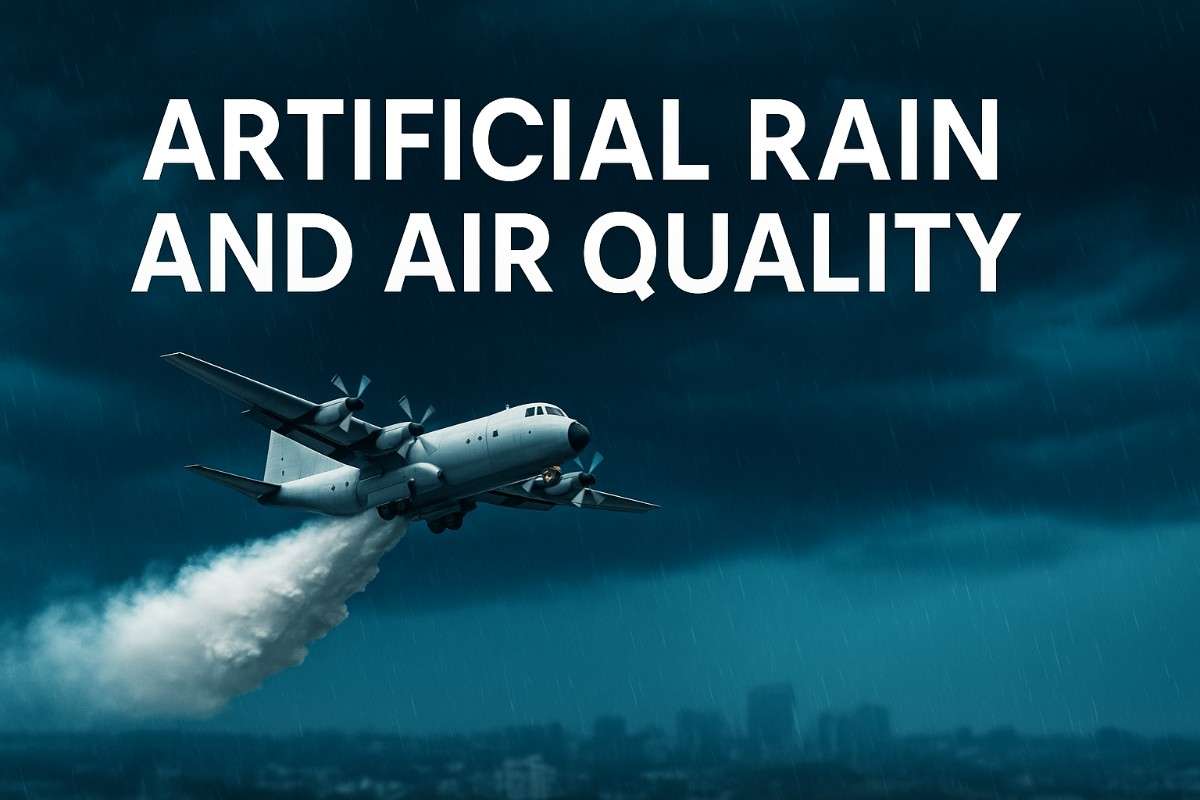
Artificial rain and air quality are closely linked through cloud-seeding technology. Scientists use artificial rain to trigger precipitation, reduce dust, and improve atmospheric conditions. This article explains how artificial rain works, examines real research studies, and evaluates its impact on air quality and pollution control.
Cloud Seeding: An Art Form
The technique called cloud seeding holds the secret to creating artificial rain. The process of “cloud seeding” entails introducing materials into clouds in order to promote precipitation. Scientists frequently use silver and potassium iodides as seeding agents because they help form water droplets.
According to research from the National Oceanic and Atmospheric Administration (NOAA), precipitation helps remove airborne pollutants through natural atmospheric scrubbing.

Usually, the procedure goes through three stages:
Meteorologists target clouds that are favorable for precipitation but need a little prodding. Meteorologists frequently consider the composition and altitude of cumulus and stratocumulus clouds.
Aircraft or ground-based generators dispense seeding agents into the sky. These substances act as centers around which droplets of water can congregate and start the precipitation process.
Causing Precipitation: Water droplets enlarge and eventually descend as rain as the seeded clouds mature. This procedure imitates the way that rain naturally forms on clouds.
Scientific Basis:
Cloud seeding has been shown to be effective in numerous scientific research. The Wyoming Weather Modification Pilot Project (WWMPP), a thorough investigation carried out by the University of Wyoming and the National Center for Atmospheric Research (NCAR), is one noteworthy example. The research, conducted between 2005 and 2014, showed that cloud seeding enhanced snowfall in specific alpine areas.
A 2017 study published in the Proceedings of the National Academy of Sciences (PNAS) investigated the effect of cloud seeding on precipitation in the Idaho mountains). The results showed a significant increase in snowfall across the seeded area, supporting cloud seeding’s potential as a technique for enhancing precipitation.
Enhancing the Quality of Air
Artificial rain has the potential to improve air quality in addition to its function in precipitation. Rainfall efficiently removes toxins and particle debris from the atmosphere, making it a natural air cleanser. The following mechanisms help explain the process.
Rainfall functions as a washout mechanism, collecting and transferring airborne particles to the ground. This works especially well at getting rid of contaminants including dust, pollen, and some pesticides.
Chemical Transformation: Because dissolved carbon dioxide is present in rainwater, it has a minor acidic quality. Because of this acidity, contaminants can change chemically and become less dangerous. This procedure, sometimes referred to as atmospheric scrubbing, helps to clean the air.

Research Studies on Enhancing Air Quality:
Researchers conducted and published an investigation of rain’s effects on air quality in metropolitan settings in the Journal of Geophysical Research: Atmospheres.. The study, which took place in a highly polluted urban area, showed that rainfall significantly reduced the amount of airborne particulate matter.
Environmental Science and Technology Letters published a thorough examination of how rain eliminates pollutants from the atmosphere. The study highlighted precipitation’s role in reducing air pollution and highlighted how it can be used as a natural remedy for cleaner air.
explore more ways natural processes improve health, read this article on super foods and their versatile benefits.
Conclusion
In conclusion, physics reveals how cloud seeding technology creates artificial rain. In addition to providing chances to increase precipitation, weather pattern manipulation also offers a potential remedy for bettering air quality. Empirical research continually demonstrates the effectiveness of cloud seeding by emphasizing its favorable effects on precipitation and, by extension, the environment.
It’s important to acknowledge the continuous improvements in meteorological science and their implications for a sustainable future as we commemorate the one-year anniversary of this piece. At the nexus of innovation and environmental sustainability, artificial rain demonstrates our ability to work with nature to achieve shared goals.
Our Social Accounts


