Cracking The Code: The Mesmerizing Science Behind Time-Bending Optical Illusions
introduction
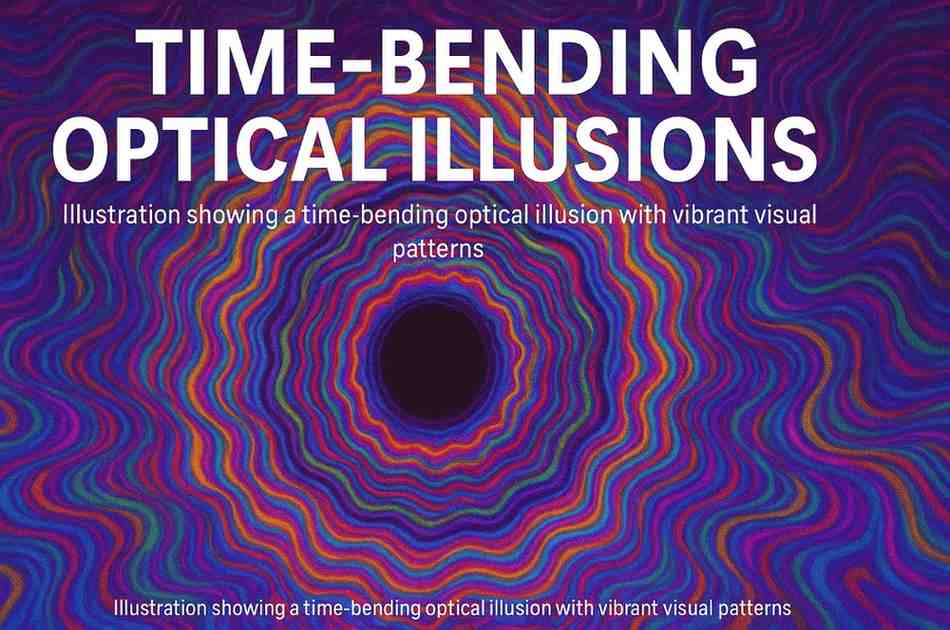
Time-bending optical illusions reveal how the brain manipulates our sense of reality and time. Optical illusions trick our visual perception, where reality and imagination collide. They deceive our senses and test our understanding of time. These illusions reveal the complex interaction between visual stimuli and the brain.
Come along on an exploration of the fascinating science underlying optical illusions that manipulate time itself. For more examples and a simple explanation of how these tricks work, you can explore this interactive guide to optical illusions from the American Museum of Natural History.

The Deception of Quietness
Have you ever looked at an apparently still image for a while just to have it come to life right before your eyes? The “stopped-clock illusion,” which creates the sensation of stillness, goes beyond temporal awareness. Imagine a clock that is at 12:34 and appears to be still. The second hand seems to spring forward, defying the laws of time, as you look away and then return.
To understand how light and frequency shape what we see, you can read my article on what colours really are and how they work.
Scientists explain this illusion through the brain’s complex processing of visual inputs. Our brains prioritize changes in surroundings. When we shift attention, motion-sensing circuits go into overdrive. This phenomena illustrates how dynamic the brain is and how it may change how time is perceived in reaction to outside inputs.
The Tunnels of Time Travelers
Enter the world of time-traveling tunnels, where perspective plays a major role in warping our perception of time. Architects and artists use forced perspective to create illusions that take viewers to different dimensions. The Penrose Stairs, an impossible stairway that flawlessly loops back on itself and tests our perceptions of time and gravity, is a prime example of a masterwork.
The brain’s difficulty resolving contradicting visual information is the basis for this illusion. Our minds struggle with contradicting signs on the maze-like Penrose Stairs. This creates temporal dissonance and makes us doubt reality. These visual wonders invite us to consider the fluidity of time itself in addition to testing our understanding of space.
The Art of Einstein’s Time Dilation
Step inside the realm of art, where Salvador Dalí’s brushwork reflects the fundamental ideas of Einstein’s theory of relativity. Master surrealist Salvador Dalí cleverly uses time dilation in his famous pieces, such “The Persistence of Memory.” This piece echoes Einstein’s theory of relative time. Melting clocks drape across strange landscapes that defy normal time flow.
Dalí’s artistic portrayal reflects the scientific fact that acceleration and gravity may cause time to distort. Viewers are drawn into a dreamlike world where time feels pliable and the ticking clock fades. Viewed through Dalí’s prism, time becomes a malleable dimension that yields to the whims of speed and space rather than an unchangeable force.
The Act of Chronostasis Vanishing:
Have you ever looked at a clock and felt that strange feeling that time is standing still? The power of the brain to control how time is perceived is demonstrated by this phenomena, called chronostasis. When we shift our gaze, the brain lengthens the first perception. This creates the impression of longer time.
If you want to see how brain activity syncs with our surroundings and other people, check my article on brain wave synchronization and how interacting with others changes us.
A temporal illusion called chronostasis calls into question how we intuitively perceive time to pass. This peculiar feature of the brain demonstrates how adaptable it is, continuously adjusting our perception to create a coherent story of the environment we live in. Chronosis acts as a reminder that time is a subjective construct shaped by the insatiably curious mind rather than an objective constant in the dance between reality and illusion.

The Motion Illusion
Motion without movement in optical illusions shows the brain’s mastery in creating reality. Consider the wagon-wheel phenomenon, in which the spinning wheel’s spokes seem to defy gravity by slowing down or even reverse their motion.
The brain’s inability to interpret rapid-fire visual stimuli leads to this captivating illusion. Our vision becomes fragmented and misrepresents the actual dynamics at work as a result of our brains seizing distinct snapshots of the motion while the wheel is spinning. The wagon-wheel effect reveals motion perception mysteries and the illusion of time through visual input and brain processing.
Conclusion
Time perception physics reveals the brain’s adaptive abilities among vivid visual illusions. These visual mysteries, from the stopped-clock illusion to Dali’s art, invite us to question the nature of time. Illusions blur the line between reality and imagination. Time becomes mysterious and reality’s borders fade. The next time you’re mesmerized by optical illusions, keep in mind that time is actually bent by the dynamic symphony of your brain, not simply your eyes.
Our Social Accounts


