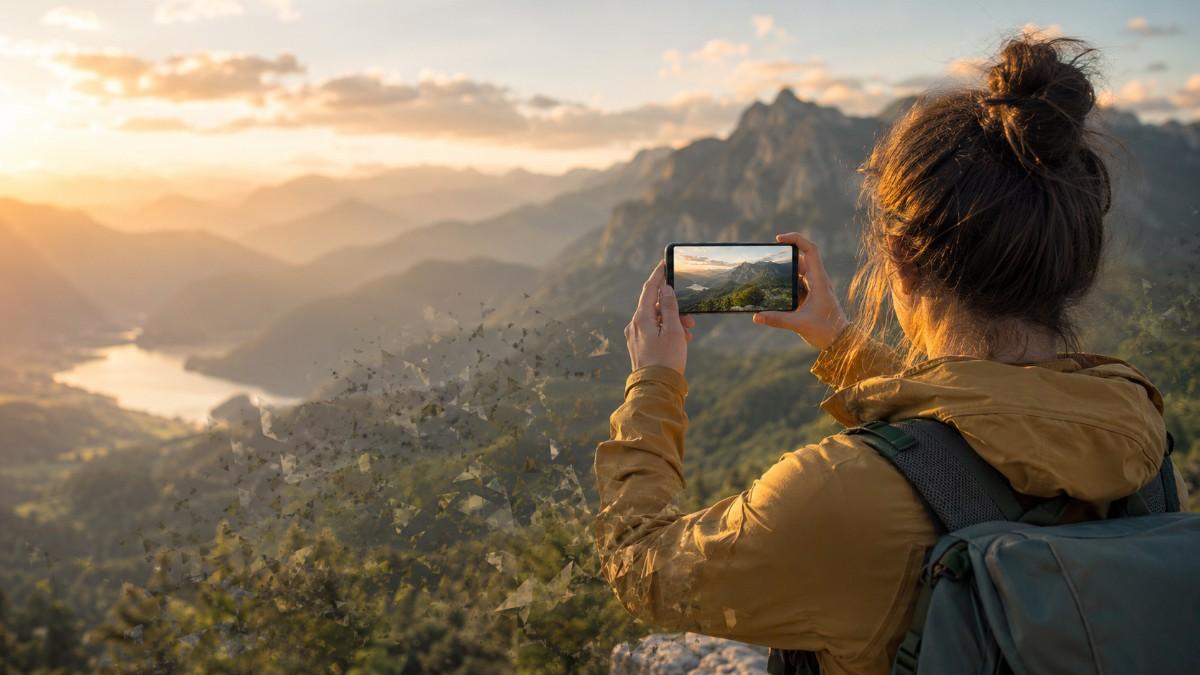
How does taking photos affect your memory?
As Hans Christian Andersen once said, “To travel is to live.” It means that we should travel to truly live, feel alive, and feel hopeful. A trip should be experienced through our own eyes rather than through a screen or a camera. Photos are meant to preserve memories. But the habit of taking too many pictures may actually weaken the memory of that experience.
Are you also someone who takes countless photos, especially during trips and vacations? Is your phone always in your hands while travelling, as you click the same mountain, monument, or view from different angles? If yes, then there is something you should know how photos affecting your memory and brain.
This raises an important question: are we collecting memories, or are we simply collecting proof that we were there? Do taking more photos actually help us remember more? If photographs affect our memory, then how do we know this happens, and what evidence do we have that it is real?
The Museum Experiment
To understand whether taking photos affects your memory or not, we have to understand and experiment conducted by Dr. Linda Henkel of Fairfield University. Dr. Henkel conducted the experiment in 2013, which they later published in Psychological Science under the title Point-and-Shoot Memories: The Influence of Taking Photos on Memory for a Museum Tour. She took students to an art museum where she asked them to interact with statues, paintings, and various objects. Some of the objects were simply observed, while others were photographed.
Then the students came back to the laboratory and the Henkel asked them to give a memory test. The questions related to the objects’ positions, details, and their locations in the museum. The results showed that participants remembered significantly less than the participants who just observed the objects. This is what Dr. Henkel called as photo-taking impairment effect.
Why Does This Happen?
Henkel explains that this happens because, while taking photographs, we outsource our memory to the camera. In other words, instead of relying on our internal memory system, we unconsciously assume that the camera will remember the information for us. We begin to think that there is no need for us to remember it because our phone will do that job instead.
As a result, our brain puts in less effort to remember the details of that particular object or moment. This is why people pay less attention to encoding the experience into memory in the first place. Psychologists refer to this phenomenon as cognitive offloading or memory outsourcing.

Instead of focusing our attention on the object or experience itself, our mind becomes occupied with framing the picture, adjusting the angle, and pressing the shutter button. Memories become clearer and last longer when we pay attention to them. If attention decreases, people do not remember the moment or its details as well as they otherwise would. In simple terms, less attention = weaker memory.
From Film Rolls to Smartphones: Photos Affect Memory
There is a significant reason behind this habit of taking too many photographs. In earlier times, when people did not widely use smartphones, only a few people owned film cameras. These cameras allowed people to take only a limited number of photographs, and every single photograph carried value. As a result, people were selective and intentional while taking pictures.
However, as time and technology have progressed, these limitations have gradually disappeared. Today, thousands of photographs can be taken using a smartphone camera. People now capture the same place from multiple angles. In fact, people take photographs of food, tickets, hotel rooms, and many other things that we may never look at again. Taking photographs has now become automatic rather than intentional.
But this change did not happen only because of cameras or smartphones. One of the biggest reasons behind it is social media. Earlier, people took photographs to preserve memories, but today they often take them to share them. People no longer ask themselves, “Do I want to remember this moment?” Instead, they ask, “Will this look good online?” The focus has slowly shifted from experiencing moments to presenting them. Trips and moments have now become content.
This constant urge to document and share our experiences also explains why taking a regular digital detox can improve our focus and presence.
When Experiences Become Content
While trying to preserve memories for the future, we are unknowingly losing parts of the present. We miss conversations, sounds, emotions, and the atmosphere of a place. However, we must remember that a camera records an image, while memory records an experience, and the two are not the same thing at all.
The abundance of photographs creates an irony of its own: out of the thousands of pictures we take, we will revisit only a few, while we leave countless memories buried in our galleries, perhaps never to see them again.

The Second Version of the Experiment
By now, we have only seen that taking pictures may not be good for your memory, but Henkel’s second experiment offers another perspective on photography. Dr. Henkel conducted a second version of the experiment in which she asked participants to take zoomed-in photographs of a specific feature of an object rather than photograph the entire object. This time, both attention and focus were required to a much greater extent.
The results of this experiment were completely different from those of the previous one. This time, the impairment effect decreased significantly, and in some cases, memory even improved. Focusing on details helped participants engage more deeply with the object.
This shows us that the problem is not photography, cameras, or smartphones. Rather, the real problem is mindless photography, automatic clicking, and outsourcing our attention. All of these reduce the amount of attention we give to an experience, and as a result, the brain puts in less effort to remember it. However, when photographs are taken with attention and focus, the experience is remembered more clearly and in greater detail for a much longer time.
And all this discussion brings us back to where we started: are we collecting memories, or are we simply collecting proof that we were there? Or do photos affect memory?
Experience First, Photograph Second
Perhaps, in the end, what truly matters is not how much proof we have collected, but how many memories we have gathered throughout our lives. There are many journeys and trips that deserve to be experienced more than they deserve to be photographed. They deserve our attention to who we are travelling with and how we are experiencing those moments, rather than to the kind of photographs we are taking.
Being fully present also allows us to have more meaningful interactions with other people, making the journey memorable beyond the photographs
As we have seen, taking photographs is not bad. In fact, a photograph should support a memory, not replace it.
So, wherever we go, we should remember to first live the moment, experience it fully, and then take photographs as well, but take meaningful ones. And always remember that a camera records only what is in front of you, while memory records what is within you.


