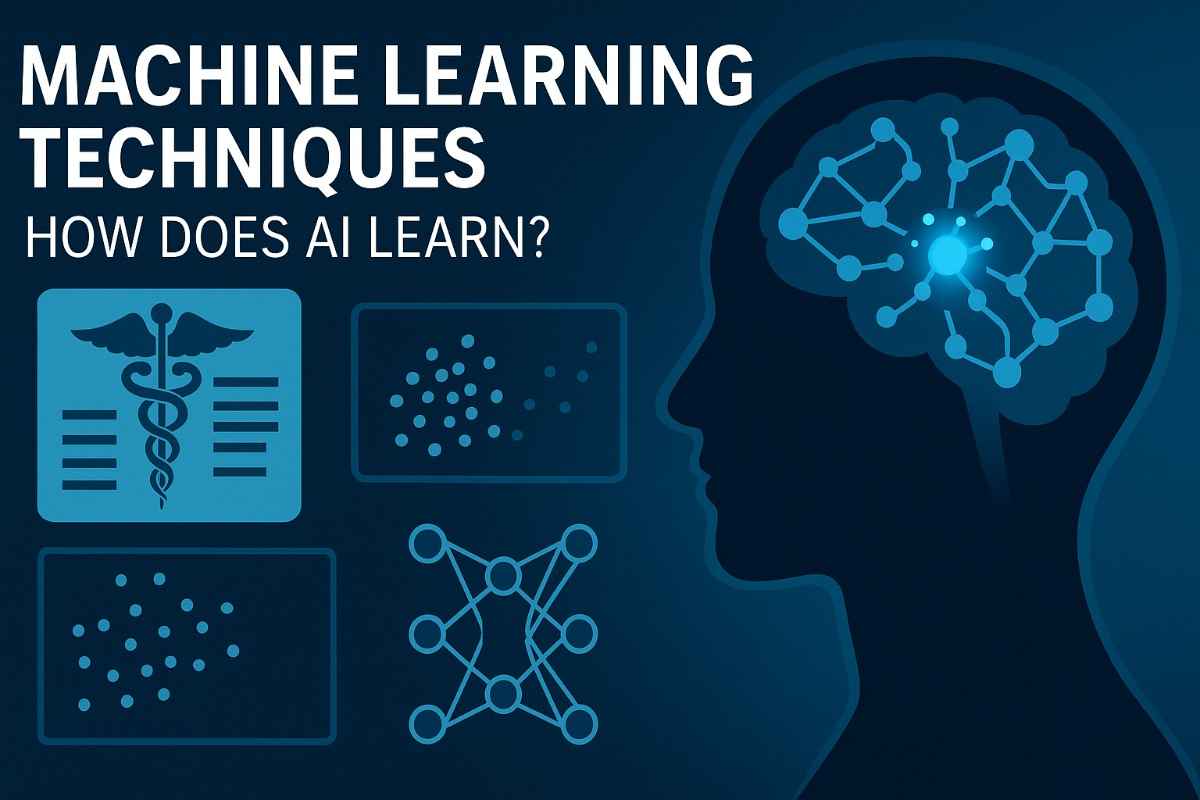
Artificial Intelligence: How does it learn? Three main machine learning techniques.
Today artificial intelligence helps doctors to diagnose patients, pilots to fly commercial aircraft, and city planners to predict traffic. Behind these advances are powerful machine learning techniques that allow AI systems to learn from data instead of following fixed rules. This is because artificial intelligence is often self-taught, working off a simple set of instructions to create unique array of rules and strategies.
So how exactly does a machine learn?
There are many ways to build self-teaching programs, but all rely on three main learning types. To see these three in action, let’s imagine researchers are trying to pull information from set of medical data containing thousands of patients profiles.
To understand how machines learn, it helps to revisit what human intelligence actually means and how it works, as explored in our article How does intelligence work?
First up, Unsupervised Learning.
This approach helps analyze profiles to find similarities and patterns. Some patients may share symptoms, or a treatment may cause similar side effects. This pattern-seeking method finds similarities and trends without human guidance.

How Supervised Learning Works in Real Medical Cases
But let’s imagine doctors are looking for something more specific. These physicians want to create an algorithm for diagnosing a particular condition. They collect medical images and test results from healthy and diagnosed patients. Then, they input this data into a program designed to identify features shared by the sick patients but not the healthy patients. The program assigns diagnostic value to features and builds a model for future patients.
Why Doctors Prefer Supervised Learning for Diagnosis
However, unlike unsupervised learning, doctors and computer scientists have an active role in what happens next. Doctors will make the final diagnosis and check the accuracy of the algorithm’s prediction. Then computer scientists can use the updated datasets to adjust the program’s parameters and improve its accuracy. This hands-on approach is called supervised learning.
Reinforcement Learning and Treatment Planning
Now, let’s say these doctors want to design another algorithm to recommend treatment plans. Because treatment plans change by patient response, doctors use reinforcement learning. The program uses an iterative approach to gather feedback about which medications, dosages, and treatments are most effective. Then, it compares the data against each patient’s profile to create their unique, optimal treatment plan. As the treatments progress and the program receives more feedback, it can constantly update the plan for each patient.
Supervised learning uses labelled datasets to train AI models on known inputs and outputs, see IBM’s overview of supervised learning for more detailed definitions and examples.
None of these three techniques are inherently smarter than any other. Each technique needs different human involvement and has strengths for specific tasks. However, by using them together, researchers can build complex AI systems where individual programs can supervise and teach each other. For example, when our unsupervised learning program finds groups of patients that are similar, it could send that data to a connected supervised learning program. That program could then incorporate this information into its predictions. Or perhaps dozens of reinforcement leaning programs might simulate patient outcomes to collect feedback about different treatment plans.

The Future of Machine Learning in Real-World Applications
These are numerous ways to create these machine-learning systems, and perhaps the most promising models are those that mimic the relationship between neurons in the brain. Neural networks use millions of connections to handle tasks like image and speech recognition. As models become more self-directed, it gets harder to understand how they reach solutions. Researchers are already looking at ways to make machine learning more transparent.
As machine learning techniques expand beyond core AI tasks, they’re already being applied in sectors like recycling and sustainable systems; for example, through green waste management technologies.
As AI becomes more common, its unclear decisions affect our work, health, and safety. So as machines continue learning to investigate, negotiate and communicate, we must also consider how to teach then to teach each other to operate ethically.
Our Social Accounts


