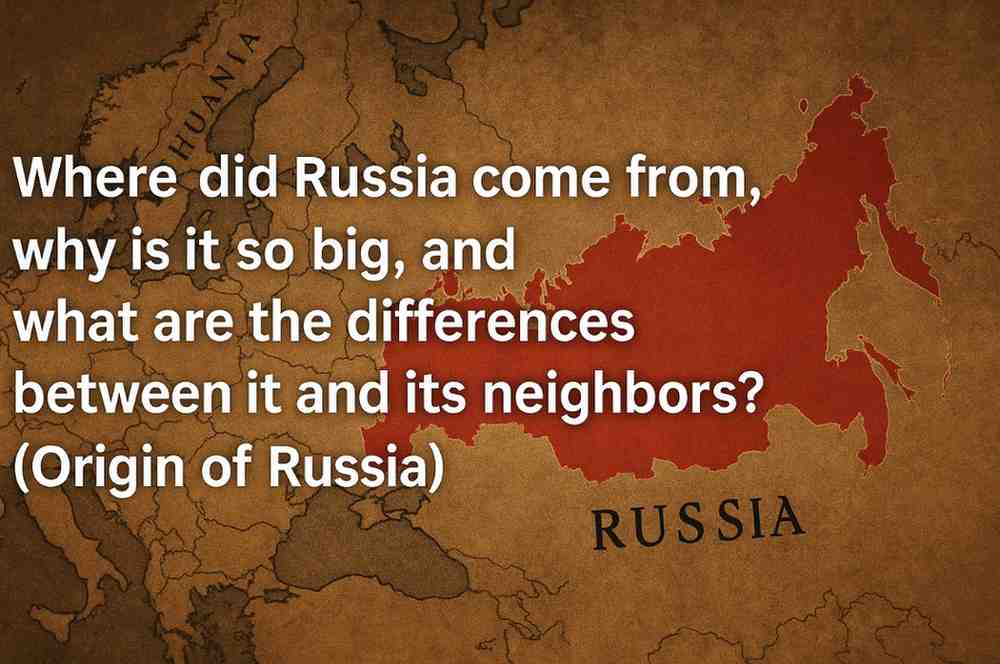
Where did Russia come from, why is it so big, and what are the differences between it and its neighbors? (Origin of Russia)
The answer of origin of Russia lies of the in an epic story of seafaring warriors, nomadic invaders, and the rise and fall of a medieval state known as Kievan Rus.
To understand the origin of Russia, we must look at Kievan Rus’ formation — see Britannica’s History of Kievan Rus for a detailed overview.
The Origin of Russia: From Tribes to Kievan Rus
In the first millennium, a large group of tribes spread through the dense woodlands of Eastern Europe. They left no writings, so our knowledge comes from archeology, Roman and Middle-Eastern scholars, and the Primary Chronicle.
For more on how names and identities evolve over time, see How Months were named/
These Slavic tribes shared a language and religion but split by the 7th century into western, southern, and eastern branches. After years under Viking rule, local tribes rebelled and drove them away, but soon began fighting among themselves.
Ironically, the tribes invited back the foreigners they had expelled to restore order.

The Role of Vikings in Shaping the Early Russian State
The Vikings accepted, sending a prince name Rurik and his two brothers to rule. With Rurik’s son, Oleg, expanding his realm into the south, and moving the capital to Kiev, a former outpost of the Khazar Empire, the Kieven Rus was born,
“Rus” most likely deriving from an old Norse word for “the men who row.” The new princedom had complex relations with its neighbors, alternating between alliance and warfare with the Khazar and Byzantine Empires, as well as neighboring tribes.
Religion and the Birth of Russian Identity
Religion played an important role in politics, and as legend goes, in 987, the Rus prince Vladimir I decided it was time to abandon Slavic paganism, and sent emissaries to explore neighboring faiths. Put off by Islam’s prohibition on alcohol and Judaism’s expulsion from its holy land, the ruler settled on Orthodox Christianity after hearing odd accounts of its ceremonies.
The Byzantine Connection: Trade, Faith, and Culture
Vladimir’s conversion, marriage to the Byzantine emperor’s sister, and trade along the Volga deepened ties between the two civilizations. Byzantine missionaries created a Slavic alphabet from Greek script, while Rus warriors served in the Byzantine Emperor’s elite guard.
For generations, Kievan Rus prospered through trade and resources. Nobles married European rulers, and cities enjoyed culture and literacy rare for that era.
Succession disputes weakened central power as rival princes in independent cities fought for control. The Fourth Crusade and Constantinople’s fall ruined vital trade and weakened Rus power as Teutonic crusaders threatened the north.
The final blow came from the east. Distracted by infighting, Rus princes ignored warnings until 1237 when Batu Khan’s 35,000 archers invaded, sacking Kiev before marching to Hungary and Poland.

Why Russia Became So Vast and Powerful
The Kievan Rus era ended, its people divided. In the Mongol-ruled east, Moscow rose as a trading post and later challenged the Khans, even replacing them in power.
Watching other Rus territories, it reclaimed the old Greek name, Russia. Western regions spared from Mongol destruction later fell under Poland and Lithuania’s influence. For the next few centuries, the former lands of Kievan Rus populated by Slavs, ruled by Vikings, taught by Vikings and split by Mongols would develop differences in society, culture and language that remain to the present day.
Read more: Cultural exchange and human interaction shape identities, see How can interaction influence your identity? for ideas on influence and connectivity.
Our Social Accounts


👌👍
Love you bro ❤
I got what you intend, regards for posting.Woh I am lucky to find this website through google. “If one does not know to which port one is sailing, no wind is favorable.” by Seneca.
Hi, Neat post. There is a problem with your website in internet explorer, might check this… IE nonetheless is the market chief and a big section of people will miss your magnificent writing because of this problem.
The problem has been resolved. Thank you for pointing out!