Unveiling the Enigmatic Origins of the Moon: A Celestial Tale
Introduction to the Origins of the Moon
Since the dawn of time, the moon has mesmerised people by illuminating the evening scene on Earth. Numerous stories, beliefs, and scientific studies have been sparked by this celestial companion’s mystifying attraction. How the moon came to be is one vexing issue that has captivated both scientists and dreamers. We explore the Moon’s development using scientific hypotheses to shed light on its puzzling origins. The origin of the moon have long fascinated scientists and storytellers, inspiring many theories about its creation.
If you enjoy exploring how cosmic events shape our world, you can also read about the origin of gold and how stars formed gold and brought it to Earth.
1. The Giant Impact Hypothesis
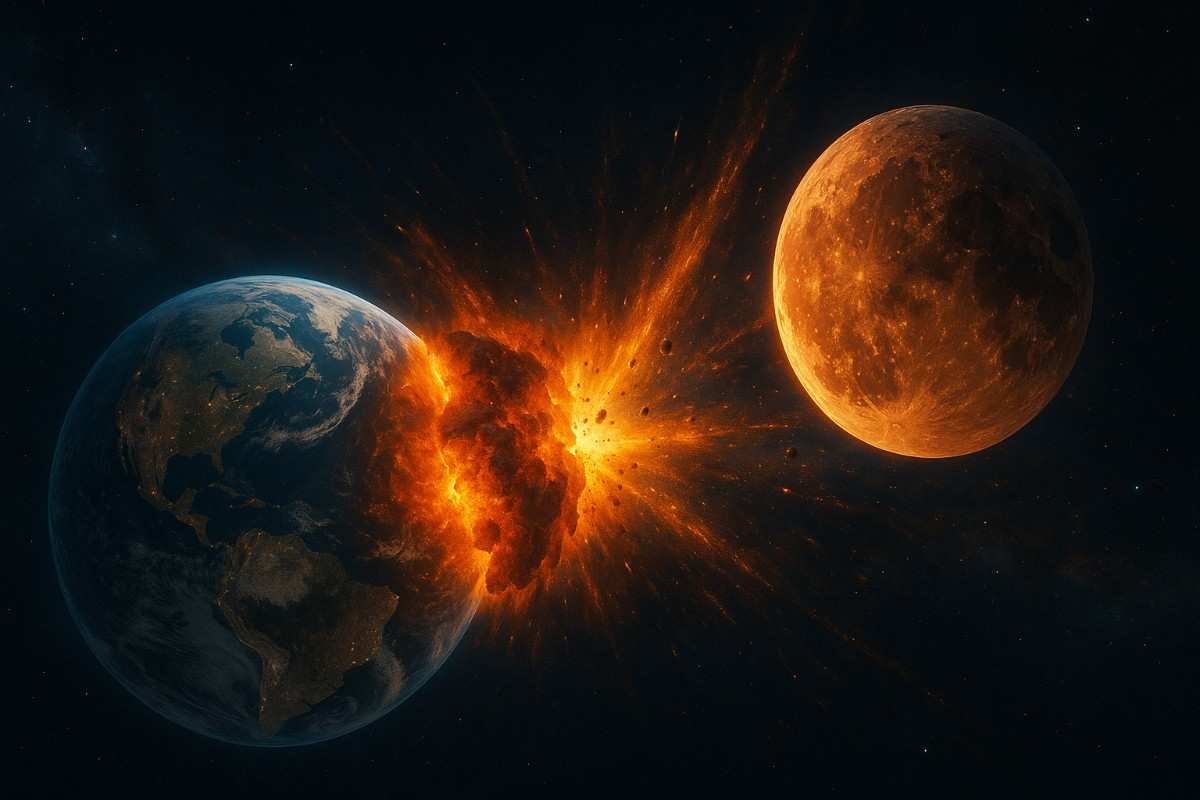
The Giant Impact Hypothesis is one widely-accepted notion that has received a lot of backing from scientists. The theory says a Mars-sized object, Theia, collided with early Earth about 4.5 billion years ago.
The crash released huge energy, ejecting debris from both bodies into space. This expelled material eventually came together to form a debris disc that now encircles the Earth.
For a detailed scientific overview of the Giant Impact Hypothesis and the formation of the Moon, you can check NASA’s explanation of how the Moon formed.

2. Moon Formation and Accretion
After the massive collision, gravitational forces caused the debris in orbit around Earth to start slowly accumulating. Planetesimals are larger things that were created as a result of small particles getting larger through collisions and mergers. Collisions and mergers among planetesimals eventually formed the protoplanetary disc that created the Moon.
3. Formation of the Moon’s Core and Mantle
Denser substances like iron and nickel gravitationally gravitated more strongly towards the protoplanetary disk’s centre as it continued to develop. The Moon’s core, which is mostly made up of these heavy components, was created as a result of this process.
The lighter substances, such silicates, stayed nearer the surface and formed the mantle. The Moon’s core is surrounded by a mantle of silicate minerals rich in oxygen, aluminium, and magnesium.
4. Lunar Crust Formation
The lighter components of the mantle gradually solidified to form the lunar crust as the interior of the Moon started to cool over time. This procedure involves the magma, or molten rock, which came from the interior of the Moon gradually solidifying.
Iron, magnesium, and calcium-rich basaltic rocks make up the majority of the lunar crust. It covers the surface of the Moon and includes a variety of landscape elements, including mountains, valleys, and impact craters.
Around 3.8 billion years ago, the Moon underwent a turbulent period known as the Late Heavy Bombardment after its formation. The inner solar system was still teeming with asteroids and comets at this time, which caused frequent impacts on the Moon’s surface.
5. Late Heavy Bombardment and Lunar Surface Features
Huge craters and basins were formed by these impacts, including the well-known Imbrium, Serenitatis, and Crisium basins, which are still readily seen today. Along with rough hills known as terrae, the lunar surface also has lowlands covered in lava known as maria.

Conclusion
Scientists are still researching and learning more about the Moon’s creation because it is such an intriguing subject. The dominant theory for the origins of the Moon is still the Giant Impact Hypothesis, which postulates a titanic impact between Earth and a celestial planet the size of Mars.
The Moon’s formation was a complicated and dynamic process, involving the accumulation of debris as well as the differentiation of its core, mantle, and crust. Its distinctive characteristics, including as maria and impact craters, remain as enduring relics of its stormy past.
Just as the origins of the Moon help us understand our solar system, looking at whether Earth is losing its water and how we can overcome water shortage problems shows how fragile our home planet really is.
Even though we now have a much better grasp of how the Moon was created, there is still much to learn and understand. More information about this celestial neighbour will undoubtedly be revealed through more study and exploration, giving us a better knowledge of the genesis and development of our solar system.
The next time you look at the Moon, think back on its fascinating origin story, which is a tale of cosmic collisions and celestial evolution that still fascinates and mystifies us today.
Our Social Accounts


Very interesting topic👏
Thank you 😊💖