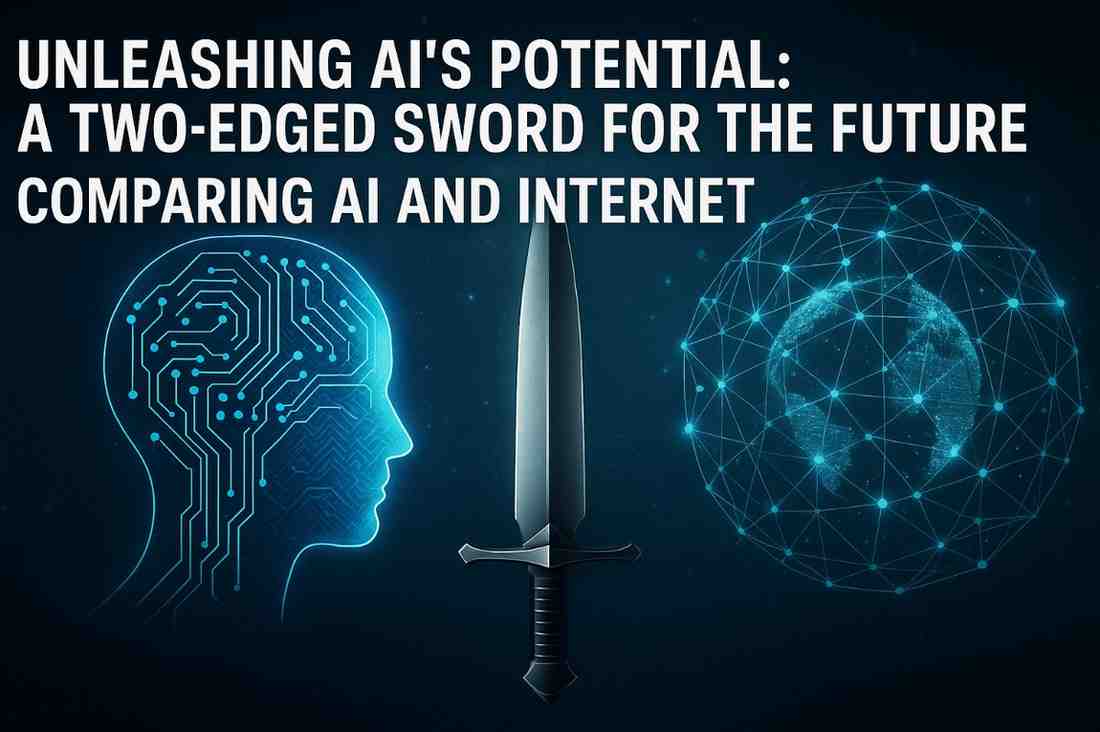
Unleashing AI’s Potential: A Two-edged Sword for the Future. Comparing AI and Internet
Artificial Intelligence (AI) is a technical advancement that holds great promise for the future, providing a route towards unheard-of expansion and creativity. AsAs the first anniversary of my birth approaches, we must consider how artificial intelligence (AI) could shape the future of humanity and stay aware of the risks when we misuse it. Let’s compare AI to another revolutionary force of the recent past, the Internet, in order to better understand its direction.
AI’s Ascent: A Symphony of Opportunities
Dubbed the “new electricity,” artificial intelligence (AI) has the potential to transform entire sectors, increase human potential, and alter civilization itself. Applications for it range from healthcare and finance to education and entertainment, and they are as varied as they are revolutionary.
AI’s capacity for learning and adaptation echoes the fundamentals of human cognition, how intelligence works on a basic level. See “How does Intelligence work? What is Intelligence and where does it begin?” for a deeper dive into the nature of intelligence.
The capacity for learning and adaptation is one of AI’s key characteristics. Artificial intelligence (AI) systems can now examine large datasets, find patterns, and make remarkably accurate predictions thanks to machine learning techniques. Because of its flexibility, AI is able to change to meet the opportunities and difficulties that arise in a variety of disciplines.

Think of the medical field, where AI helps with disease diagnosis, prognostication, and even creating customized therapy regimens. This improves the accuracy and effectiveness of healthcare interventions in addition to quickening the rate of medical developments.
Business-wise, AI-driven analytics provide priceless insights that make data-driven decision-making easier. AI helps businesses remain ahead in a constantly changing environment by doing everything from forecasting market trends to streamlining supply chains.
The combination of AI and robotics is ushering in a new era of automation. Although this raises concerns about employment displacement, it also creates opportunities for people to work on more imaginative and thought-provoking projects. Artificial intelligence (AI) has the ability to relieve monotonous and routine work, which could stimulate human creativity again.
The Shadow Side: Getting Through Ethical Minefields
AI’s rise brings real risks, and we must consider the ethical consequences carefully. A primary problem is privacy. AI systems gather massive amounts of data, which raises concerns about who owns and protects personal information. We struggle to balance innovation with privacy.
Algorithm bias in AI presents another ethical dilemma. When developers train AI systems on skewed datasets, they strengthen and even perpetuate existing societal prejudices. In order to address this problem, we must ensure that training data is representative and diverse.
Internet vs. AI: A Comparative Odyssey
Comparing AI to the Internet reveals fascinating things about the nature of technology revolutions. In the 21st century, the Internet foreshadowed artificial intelligence by democratizing knowledge, establishing global connectivity, and ushering in the digital age.
But AI goes beyond the Internet’s capacity for information sharing. It comprehends, learns, and adapts in addition to processing data. Artificial intelligence will transform decision-making and problem-solving in many fields, just like the Internet transformed communication and information access.
However, there is a deep ethical thread that unites the two. People first praised the Internet as a force for good, but cybersecurity risks, disinformation, and privacy violations quickly tarnished its utopian image. Similar ethical dilemmas face AI as it develops, but with greater consequences.
The rise of constant connectivity and information overload, once hailed as an advantage, also demands balance. For more on how continuous digital exposure affects mental health and why stepping back helps, check out “The Benefits of Digital Detox: Why Digital Detox Is Essential In This Hyperconnected World.”

Looking Ahead: A Peaceful Cohabitation
It is essential that we take a balanced approach as we traverse the unknown waters of an AI-driven future. A symbiotic relationship between ethical responsibility and technological innovation is necessary to embrace the possibilities for growth.
Laws and policies need to change to keep up with artificial intelligence’s quick advancements. Governments, businesses, and the larger international community must work together to strike a balance between promoting innovation and defending moral values.
In this revolutionary age, education appears to be crucial. Giving people a thorough grasp of AI’s potential, constraints, and ethical ramifications enables them to make wise decisions. A population that is digitally savvy is better equipped to use AI for advancement as a whole.
To help organizations develop safer and more transparent AI systems, the National Institute of Standards and Technology introduced an AI risk management framework that outlines practical guidelines for reducing bias, improving accountability, and protecting users.
In summary, the story of AI’s future develops into an engrossing tale of boundless possibilities and moral conundrums. Comparing its development to that of the Internet demonstrates how technology revolutions are cyclical, with waves of innovation followed by waves of moral dilemmas. Let’s approach the path of AI enlightenment with cautious optimism as we commemorate the first year of my life, making sure that the ethical notes that our society’s conscience resonates with the symphony of possibilities it presents.
Our Social Accounts


