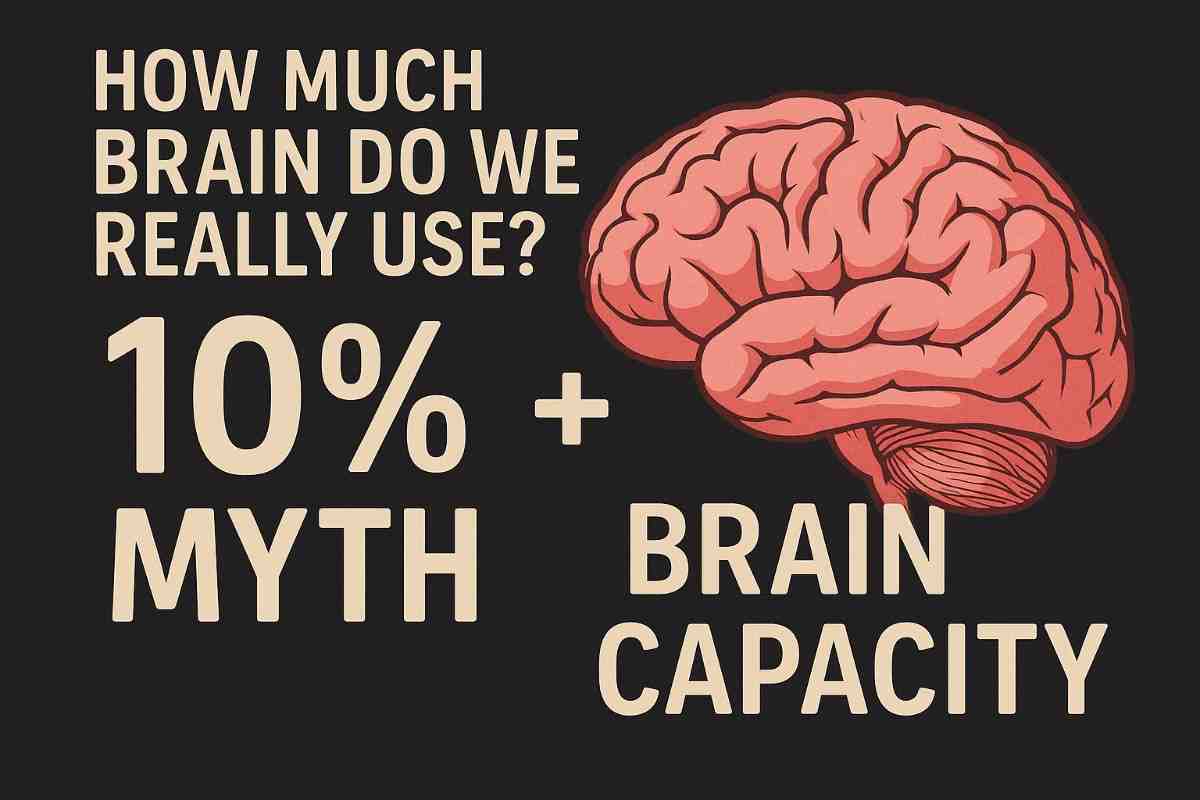
Do you use only 10% of your brain? If not, then how much do we use our brain?
An enduring myth says we use only 10% of our brain, but the truth about brain capacity is far more fascinating. Hucksters promised to unlock that hidden potential with methods “based on neuroscience,” But all they really unlock is your wallet. Two-thirds of the public and nearly half of science teachers mistakenly believe the 10% myth. In the 1890s, William James, the father of American psychology, said, “Most of us do not meet our mental potential.” James meant this as a challenge, not an indictment of scant brain usage. William James, the father of American psychology, once said, “Most of us do not meet our mental potential.” Read more about the 10% brain myth to understand how this idea spread.
Misunderstood ‘Silent Areas’ of the Brain
But the misunderstanding stuck. Also, scientists couldn’t figure out for a long time the purpose of our massive frontal lobes or broad areas of the parietal lobe. Damage didn’t cause motor or sensory deficits, so authorities concluded they didn’t do anything. For decades, these parts were called silent areas, their function elusive. We’ve since learned that yhey underscore executive and integrative ability, we would hardly be human. They are crucial to abstract reasoning, planning, weighing decisions and flexibly adapting to circumstances.
How Our Brain Capacity Really Works
The idea that 9/10 of your brain sits idly by in your skull looks silly when we calculate how the brain uses energy. Rodent and canine brains consume 5% of total body energy. Monkey brains use 10%. An adult human brain, which accounts for only 2% of the body’s mass, consumes 20% of daily glucose burned. In children, that figure is 50%, and in infants, 60%. To understand how everyday technology may affect our brain, see this article on how mobile phones impact brain health.

Neurons, Brain Size, and Human Intelligence
This is far more expected for their relative brain sizes, which scale in proportion to body size. Human ones weigh 1.5 kilograms, elephant’s brain 5 kg, and whale’s brain 9 kg, yet on a per weight basis, humans pack in more neurons than any other species. This dense packing is what makes us so smart. There is a trade-off between body size and the number of neurons a primate, including us, can sustain. A 25 kg ape has to eat 8 hours a day to uphold a brain with 53 billion neurons.
The invention of cooking, one and a half million years ago, gave us a huge advantage. Cooked food is rendered soft and predigested outside of the body. Our guts more easily absorb its energy. Cooking frees up time and provides more energy than if we ate food stuffs raw and so we can sustain brains with 86 billion densely packed neurons. 40% more than ape.
Why We Can’t Use 100% of Our Brain at Once
Here’s how it works. Half the calories a brain burns go towards simply keeping the structure intact by pumping sodium and potassium ions across membranes to maintain an electrical charge. To do this, the brain has to be an energy hog. It consumes an astounding 3.4×10^21 ATP molecules per minute. ATP being the coal of the body’s furnace.
The high cost of maintaining resting potentials in all 86 billion neurons means that little energy is left to propel signals down axons and across synapses, the nerve discharges that actually get things done. Even if only a tiny percentage of neurons fired in a given region at any one time, the energy burden of generating spikes over the entire brain would be unsustainable. Here’s where energy efficiency comes in. Letting just a small proportion of cells signal at any one time, known as sparse coding, uses the least energy, but carries the most information. Because the small number of signals have thousands of possible paths by which to distribute themselves. A drawback of sparse coding within a huge number of neurons is its cost.
Worse, if a big proportion of cells never fire, then they are superfluous and evolution should have jettisoned them long ago. The solution is to find the optimum proportion of cells that the brain can have active at once. For maximum efficiency, between 1% and 16% of cells should be active at any given moment. This is the energy limit we have to live with in order to be conscious at all.

The Amazing Efficiency of Human Brain Capacity
The need to conserve resources is the reason most of the brain’s operations must happen outside of consciousness. It’s why multitasking is a fool’s errand. We simply lack the energy to do two things at once, let alone three or five. When we try, we do each task less well than if we had given it our full attention. The numbers are against us.
Your brain is already smart and powerful. So powerful that it needs a lot of power to stay powerful. And so smart that it has built in an energy-efficiency plan. So don’t let a fraudulent myth make you guilty about your supposedly lazy brain. Guilt would be a waste of energy.
After all this, don’t you realize it’s dumb to waste mental energy? You have billions of power-hungry neurons to maintain. So hop to it!
Our Social Accounts


excellent post, very informative. I wonder why the other experts of this sector don’t notice this. You must continue your writing. I am confident, you’ve a great readers’ base already!
Thank you for your inspiring comment. 🙏
Thanks for sharing your thoughts about there.
Regards
It’s a pity you don’t have a donate button! I’d without
a doubt donate to this superb blog! I guess for now i’ll settle for bookmarking and adding your
RSS feed to my Google account. I look forward to new updates and will talk about this blog with my Facebook
group. Talk soon!
Howdy very nice blog!! Guy .. Excellent .. Superb .. I’ll bookmark your website and take the
feeds additionally? I’m happy to seek out numerous useful info right here within the put up,
we want work out more strategies on this regard, thanks for sharing.
. . . . .
Hello! I know this is kinda off topic but I was wondering which blog platform
are you using for this website? I’m getting tired of WordPress because I’ve had
issues with hackers and I’m looking at options for another platform.
I would be awesome if you could point me in the direction of a
good platform.
Simply want to say your article is as amazing.
The clearness in your post is simply nice and i could assume
you are an expert on this subject. Well with your
permission allow me to grab your RSS feed to keep updated
with forthcoming post. Thanks a million and please carry on the gratifying work.
Thank you!!!
hello there and thank you for your information – I have definitely picked up anything new from
right here. I did however expertise a few technical points using this web site, as I experienced to reload the website lots of times previous to I could get it to load correctly.
I had been wondering if your hosting is OK? Not that I’m complaining, but sluggish loading instances times will very frequently affect your placement in google and could damage
your quality score if advertising and marketing with
Adwords. Well I am adding this RSS to my email and could look out for a lot more of your respective fascinating content.
Ensure that you update this again very soon.
Thank you!!!
What’s Going down i’m new to this, I stumbled upon this I’ve discovered It absolutely useful and it has helped me out loads.
I am hoping to contribute & aid different customers like its
helped me. Great job.
Thank you!!!
A person necessarily help to make seriously
posts I would state. That is the first time I
frequented your website page and thus far? I amazed with the research you made to create this
particular post extraordinary. Magnificent task!
Thank you!!!
I do not even know how I ended up here, but I thought this
post was good. I do not know who you are but definitely you’re going to a
famous blogger if you aren’t already 😉 Cheers!
Thank you!
I must thank you for the efforts youve put in penning this site. I am hoping to check out the same high-grade blog posts by you in the future as well. In fact, your creative writing abilities has motivated me to get my very own blog now 😉
Thank you!
Would love to forever get updated outstanding web site! .
Real instructive and good anatomical structure of articles, now that’s user friendly (:.
Thank you!